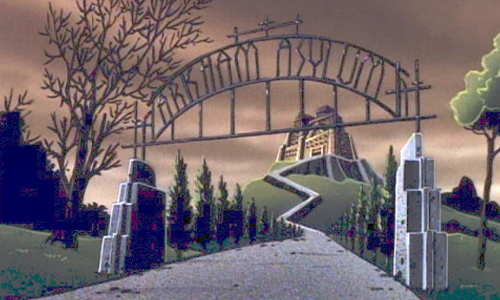
The actual first scene of the film is not the newsreel sequence, but several shots of Xanadu and finally Kane’s death. Then Welles cuts to the newsreel footage. This first scene draws a distinctly different portrait of Kane than the plot summary of the newsreel. We first see Xanadu from behind its barred gates. It resembles a prison more than a home. Am I the only one reminded of Arkham Asylum from Batman: The Animated Series?
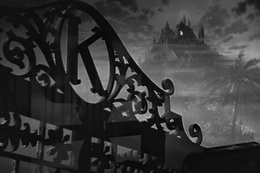
The mansion is seen at night, completely dark but for one room and shrouded in fog. This comes in sharp contrast with the bright lights and images of the newsreel’s depiction of Kane’s life. When the camera finally brings us to Kane, the darkness and isolation of his home prepare the viewer for a man similarly alone in the world. When he does die, a nurse matter-of-factly pulls a sheet over his head and leaves. Though the newsreel mentions his solitary existence, the sadness of his situation is much more pronounced in the initial view that Welles gives his viewers. This scene also hints that “Rosebud” is not the name of an old girlfriend and is probably not as simple as the newsmen imagine. We can imagine that there must be some significance to the snow globe that falls from Kane’s hand. Why else would Welles cut to a shot taken from the shattered bauble’s perspective and why else would this be the last thing Kane held before his death?
These unanswered questions make it clear from the start that the film is going to be more about delving into the psychology of Charles Foster Kane than about his life itself. After the newsreel plot summary, we go over his life from a different “angle” as the reporters call it. The enjoyment we get from this film is not unlike the enjoyment gained from reading a book for a second time. We see details that otherwise would have escaped our notice and we get a richer perspective on the story. The editor in the screening room seems to be aware of this. He enjoyed the initial cut of the newsreel that Welles shows us but also feels that there needs to be more to make a truly quality product. This is a moment of meta-criticism for Welles and it seems to be a shot at the Hollywood establishment for making films that are enjoyable, fast-paced, but ultimately lacking the “angle” of a deeper meaning. Welles’ reporter and by extension his camera (and the viewers) go in search of that something extra and the end result is one of the classics of American cinema.

8 comments:
Welles is an excellent director to contemplate for what you call "meta-criticism" here. Beyond what deeper meaning the film gives us into Kane as a character, the film is also commenting how different "angles" (yes by the camera, but also more broadly: approaches, genres, industries even) construct meaning differently. Great reading of the first scene! This skill for close reading will really help out your shot by shot analysis.
Cullen, I agree that Citizen Kane is not so much about the plot, but more to give us a look into Kane's character. I would have liked to hear your thoughts on how this relates to Metz. Why do you think Wells revealed the plot the way he did? If his true focus was on Kane's inner-self and why did he take the trouble of spending that time on the plot?
I think that the point of this movie is to demonstrate that the American Dream isn't all that it is made out to be. It can't bring satisfaction, and sometimes, in pursuit of it, people can lose what is actually important. Rosebud. A sled. Childhood. Parents. Love. Kane spends all of his life trying to buy love and happiness and realizes that it can't happen in the end. Had he not been shipped off to wealthiness, he may have had a much more fulfilling life. I don't know: I'm not a doctor. I'm not a psychologist. But I do know that he missed out on the one time in the film in which he is truly happy. His childhood, throwing snowballs in the West, where the American Dream was originally created, is lost. Then he just tries to make up for it by buying or simply owning or simple movement. The lie of fulfillment through capitalism creates a shell of a man. A broken man as we see in the end of the film. True happiness or contentedness comes from genuine relationships and love and importance.
I like how you start with asking why the film gives the basic plotline away at the start, and then goes on the re-hash it all in an additional 110 minutes. I think you are right about the reason here, mainly because I felt like I knew Kane by the end of the film, and understood "what makes him tick," as you put it. Welles clearly had a very very specific man in mind, and as a result of his consitency and detail in portraying Kane, we come to know this man well. In turn, our sympathy in this situation runs deeper, becomes more personal. I cannot begin to describe how moved I was by one particular moment (literally, it was maybe 1 second long) at the end of the film. It is after Kane has his violent breakdown after Susan leaves him. He is standing with the snow globe in hand and the camera pans up to his face. Then, Welle's lip drops, ever so slightly. That whole scene, but particularly that moment, actually made me tear up. This wouldnt be possible had I not felt a sincere, real-life connection with this character. It is truly amazing. I have thought about whether or not the fact that Welles is both the actor Kane AND the director who chose how to portray him contributes to the success of this aspect of the film (aka-- he knew exactly what he wanted both from the acting and filming sides of the formula).
For me, I think the reason why Welles elaborates into a 110 minute dilm instead of a synopsis is because, simply put- it’s more interesting to watch. I liked Citizen Kane because I love learning about the inner workings of a person- I think many of us do. That’s why there’s such a craze with paparazzi and media frenzy, we want to know about our favorite celebrity’s personal life and about the celebrities we worship and who make millions. It’s like voyeurism in a way, we want to be able to observe people. “This is not a movie about the outer life of an American tycoon – the movie tells us that even Kane’s private life is public knowledge – rather it is about his inner life, what makes him tick, what Kane feels in his heart.” Unfortunately, as the film details, most of the time we can never really truly find out all the “inner tickings” of a person. That is the mystery of life and what keeps stories like Citizen Kane so interesting. This film shows just how difficult it is to unravel personal stories.
Your clips were unfortunately removed due to copyright infringement, but that's quite alright, since we all know what you were referring to!
I'm so glad you analyzed the director's choice in narrative layout, because I agree, it definitely has meaningful implications as to what he was trying to achieve.
Although the fact that the plot is laid bare for us immediately might be considered counter-intuitive. After all, one of the supposed merits of a "good film" is to grab the viewer's attention and keep him or her on the edge of the seat. Citizen Kane is not like that. Other than the mystery of Rosebud, there's not much that we don't already know will happen. However, the deeply intimate glimpse we are given - privileged with - of Kane's life makes up for that. I did not feel any lapse in interest during the film despite the initial transparency of the plot, for the same reason many others did not, because the story of the real man was far more interesting than the myth.
I like your analysis of the opening scene of the film. There is something that you touch on briefly but I think is rather important in reading the film overall. The use of angles in this film. Obviously the movie uses different "angles" (different POV) to tell the life of Kane, but it also uses different camera angles. Often he uses low angle shots when Kane is present to make him appear larger than life, obviously symbolic. Later he uses high angle angle shots to show his wealth which makes it appear small and unimportant. Obviously these were decisions on the part of the director to highlight the transient nature of wealth. I agree with your categorization of the film as a psychological piece, an exploration of an inner man's psyche.
I think the brilliance of Citizen Kane is that it's a film that, after ten minutes, makes you feel like you have all the answer. He was a philanderer, an idealist, a successful titan who let it all slip away. He died alone, but will be remembered for what he did. It's simplistic, but it's there. And then, the next 100 minutes purport to give us the deeper answers, but in fact leave us with deeper questions. Rosebud, a memory of his lost childhood, seems important to him, and the symbol of his lost childhood explains a bit. But, we can't help but question what his motives in life were. He certainly was hungry for power, but that also wasn't everything to him. He tried to help the "common man," but did he really care? He's a man of such contradictory traits, that Welles, via the reporters, concedes we can never know anything about him. And that is the ultimate point. Even in a film widely considered the greatest of all time, it would be unfair to say that we fully know Charles Foster Kane. We have many questions left, even after such a vivid portrait. No matter how many new details, new facial ticks on Welles's face, new vocal tones we catch, we will never fully know Kane. And that mystery, perhaps, is what makes Citizen Kane great.
Post a Comment