Friday, December 4, 2009
Boyz 'n the Hood: A Treatise on Violence
In his 1991 film Boyz ‘n the Hood, first time director John Singleton follows the lives of three boys growing up in a poor, crime-ridden neighborhood in South Central Los Angeles. Singleton’s protagonist, Tre (Cuba Gooding, Jr.), lives with his father Furious Styles (Laurence Fishbourne) and comes of age under the strict rules and expectations of this strong male figure. Tre’s best friend is Ricky (Morris Chestnut), a high school football star with the drive to make a better life for his family. Ricky lives with his single mother (Tyra Ferrell) and his half brother Doughboy (Ice Cube), a gang leader who has given in to the allure of the street but still remains part of the trio of childhood friends. The peak of the movie’s plot arc comes when the three boys are high school seniors. Following a minor spat with some rivals of Doughboy’s gang, Ricky is gunned down in cold blood as Tre helplessly watches nearby. Singleton presents the violence of Ricky’s death by contrasting a few cinematographic conventions with a variety of unusual techniques that serve to sharpen our awareness of what we see onscreen. His use of sound, slow motion, close up, and the focus pull forces the audience to feel the full weight of Ricky’s death and confront our own perverse fascination with violence. In this way, the form of Boyz ‘n the Hood brings home the message of the film well before the final credits roll: violence in low income communities is tacitly accepted by most Americans who are desensitized to it and thus ignore the reality and humanity behind death.
This paper will primarily focus on a sequence of the five main shots that encompass Ricky’s shooting and the ways in which the director breaks with traditional continuity editing practices in order to increase the viewer’s awareness of the horror and reality of the action onscreen. The juxtaposition of a few standard filmmaking techniques with these unusual editing decisions furthers Singleton’s purpose with the scene. Shot 1 starts the clip, which takes place at 1:28:23 of the full film’s run time. Ricky notices the gang members at the end of the alley and begins to run away from them, towards the camera. Shot 2 cuts to a close up of the shooter in the car as he pulls the trigger of his shotgun. Shot 3 shows Ricky being hit in the leg by the blast and stumbling as he continues to flee his attackers. Shot 4 is an even tighter shot of the shooter as he fires again, followed by a quick cut to Shot 5 which shows Ricky being struck by this fatal shot.
In this sequence, the most noticeable departure from conventional cinematography appears in Singleton’s unusual treatment of sound. As soon as Ricky looks up to see the gang members aiming a shotgun at him, the diegetic sound and the musical score go silent. We do not hear the sound of Ricky’s footsteps as he runs away from his attackers and we do not hear the kind of heavy breathing that would typically accompany the kind of exertion his strained facial expression implies. Instead, there is a brief period of silence, followed only by the sounds of a dog barking and a child laughing. Given the neighborhood setting of this scene, at first blush these sounds might be thought to come from a nearby yard or park. But upon closer consideration, this theory does not hold up. There is no evidence on screen of any children or animals at play around the alley. In addition, the sounds come through much too clearly to be incidental carry over from off screen space, especially from sources that are never seen or mentioned elsewhere.
Instead, Singleton has inserted these sounds as a reflection of the audience itself. The barking dog, which is heard first, represents the baser desires of the viewer, our animal instincts. Ricky can be seen here as a hunted animal, with the shooter as the hunter, the pursuer. By associating the audience with the dog, a hunting animal, rather than with Ricky, Singleton points out our perverse desire to see Ricky get shot. At the psychological level of the id, we still take some pleasure in the pain of others. The sound of a child’s laughter is heard next, representing again that instinctual enjoyment of violence and pain. The sound feels completely out of place in this shot as it is contrasted with Ricky literally running for his life. This “contrapuntal use of sound vis-à-vis the visual [images]” (Braudy/Cohen 316) harks back to some of the earliest critiques of the use of sound in cinema. Russian theorists Sergei Eisenstein, Vsevolod Pudovkin, and Grigori Alexandrov state that the full power of a visual montage can only be realized if sound is used “at a sharp discord with the visual images” (Braudy/Cohen 316). This usage of sound increases the individual value (and thus the combined value) of the juxtaposed shots in this sequence.
The strangeness of the laughter and its complete incongruity with the gruesome images of a man gunned down in cold blood also serve to heighten the horror of Ricky’s death. The effect of the laughter calls to mind the use of children in horror films; normally associated with innocence, taken in a different context children can become scary and off-putting. The queasy feeling generated here builds on this effect by tacitly making the audience the source of the strangeness. The laughter reflects our inner enjoyment and acceptance of violence, not an easy revelation to come to grips with.
While no audience would ever actually laugh out loud at a moment like this, the jarring laughter that we hear attributed to us forces a recognition of the fact that there are elements of death in cinema that we enjoy. Take for example almost any typical action movie. The Star Wars movie franchise has spawned a world wide pop culture phenomenon, helped usher in the era of the blockbuster, and firmly established war and violence as one of its central themes. The films revolve around epic battle sequences that result in the casual deaths of thousands of foot soldiers. British super spy James Bond, star of history’s longest running movie franchise, disposes of his enemies via his famed ‘license to kill,’ a similarly mindless exercise in human death. In contrast, Singleton wants his audience to feel the full significance of Ricky’s death as a unique event and also to feel sick at the realization that watching this occur on screen can often be a source of enjoyment for us.
To drive this point home even further, Singleton elects to show Ricky’s flight down the alley in slow motion. As Walter Benjamin argues, slow motion extends movement, “presents familiar qualities of movement but reveals in them entirely unknown ones” (Braudy/Cohen 680), and thereby teaches us more about the action than we would normally understand. “The camera introduces us to unconscious optics as does psychoanalysis to unconscious impulses” (Braudy/Cohen 680); by this understanding of slow motion, we can see that Singleton’s decision to utilize it here ties in perfectly with his use of non-diegetic sound. The sound makes us aware of our perverse psychological instincts while the use of slow motion makes us feel Ricky’s humanity all the more by breaking down his run and extending it, thus increasing our emotional involvement in the scene. Drawing the death out as the director does here forces the audience to fully consider the death of a human being without the easy escape of a cut or transition away from the victim that is common in many typical Hollywood depictions of death.
Singleton presents sound and motion in these unconventional ways in order to jar the audience out of our everyday passive viewing experience. He makes us uncomfortable by way of the inappropriate pairing of happy sounds with images of death. By presenting the scene in slow motion, the director extends this discomfort long enough for us to realize that the laughter is coming from us and from our perverse enjoyment of what we see on screen. But what differentiates Singleton’s break with the conventions of continuity from other instances where directors set aside these norms? After all, slow motion and other atypical cinematographic techniques are actually somewhat common in filmic depictions of violence or sex. Witness the stylized portrayal of death in the clip from Zack Snyder’s 300 below. It glosses over the grittier aspects of battle, fitting in with Marinetti’s aesthetic that Benjamin references: “War is beautiful because it creates new architecture, like that of the big tanks, the geometrical formation flights, the smoke spirals from burning villages, and many others” (Braudy/Cohen 684). This idea of war emphasizes the visual spectacle over the harsher reality of death that Singleton gives us. Though Snyder shows the blood and gore, he does so in a way that downplays any aspect of suffering and instead presents death more as a visual symphony.
http://www.youtube.com/watch?v=h8bIEk58LzI&feature=related
While Snyder shows death in slow motion in 300, he focuses mostly on the killer, quickly panning back to the Spartan warrior; with his camera, he abandons the dead and dying. In most films where death is approached unconventionally as it is in 300, the killer is the point of emphasis even if the victim is a major character.
But Singleton chooses to make his killer an anonymous figure, not even worthy of a mention by name. The director depicts this killer with very standard film techniques, a noticeable juxtaposition when compared to his treatment of Ricky. Our first shot of the shooter consists of a close up and a stationary camera trained on his face. He is completely unemotional throughout the killing, a stark contrast to the straining, fearful faces we see from Ricky (emphasized further by the slow motion). The killer fires his first shot, smoke fills the screen, and then clears to reveal an unchanged facial expression. In short, he is a blunt, inhuman instrument. The second shot of him develops this connection through an even tighter close up, followed by a focus pull from his face to the barrel of the shotgun. The visual message indicates that man and weapon are one and the same.
Other than the focus pull, the filmic presentation of the killer simply drips with convention. His actions take place in real time – no slow motion – and the sound of his gun firing and cocking are the only elements of diegetic sound in this sequence. Not only does this emphasize the unusual portrayal of Ricky, the straightforward shots of the shooter coincide with the very basic level on which we identify with him. The primal rage in his eyes becomes visceral through the close ups and the audience takes pleasure in this much as we do in watching violence. The effect of the focus pull as the shooter fires the second time is to show the audience how inhuman and mechanical his perspective is and, like the laughter, points to the perversity of our viewing emotions. How horrifying, Singleton seems to say, that what we get from this scene is pleasure from the actions of a mere instrument (the gun) rather than an understanding of how truly awful it is to experience the death of another human being.
Through the contrast of conventional and unconventional film techniques, Singleton uses the form of his film as much or more than he uses plot in order to convey meaning. Not only does he show how senseless violence can be, but he holds his audience partially responsible for it. Due to our enjoyment of violence in film, Americans have become desensitized to it in reality and ignore the humanity behind death. Our perverse instincts cause us to see violence – in the news, in film, or elsewhere – as entertainment and thus do not motivate us to work to eliminate it. Singleton strives to portray Ricky’s death in a manner that will break us out of this ideology and appreciate the emotional magnitude of violence in the inner city.
But Singleton takes his message one step further. His usage of sound and slow motion effectively accuses the viewer of enjoying and therefore tacitly supporting the murder of Ricky. He then employs standard cinematographic practices to tie that animalistic pleasure to the analogously id-driven rage of the killer. Interestingly though, the killer is black, just like Ricky, adding a complex racial element into the mix. By choosing to make both the shooter and the victim black, Singleton seems to be addressing the African-American audience in particular when he criticizes the viewers’ glorification of violence. This indictment of the black community as a major contributor to violence against blacks stands in opposition to the message found in many films made around this time, including some by perhaps the most famous African-American director of the early-90s, Spike Lee. In Lee’s Do the Right Thing, released just two years prior to Boyz ‘n the Hood, one of the major themes revolves around tension between racial groups. The violent conclusion of that film is initiated by a fight between a middle-aged white Italian and a young black man – racial conflict is at the heart of the movie.
Throughout Boyz, Singleton emphasizes the senselessness of the black-on-black crime and hatred that is so prevalent in South Central L.A. Black police officers discriminate against black civilians rather than stand up for their brothers. Black men shoot other black men in alleyways over minor slights to their street cred. Tre’s father Furious recognizes this self-discrimination and gives an impassioned speech about the importance of African-American cooperation, saying “It’s the ‘90s; we can’t afford to be afraid of our own people any more.”
Ricky’s death as Singleton shows it implicates the audience, holds us partially responsible for condoning the violence that destroys inner-city communities. He uses film techniques to draw out and personalize the violence he portrays, engendering guilt in his audience for finding a measure of enjoyment in it. This message is directed especially at the black viewer because Boyz ‘n the Hood primarily concerns itself with ways in which the African-American community can improve from the inside. Unlike many other black directors of the time, Singleton deems the impact that white society can have on the ‘hood as negligible and instead uses the form of his movie to condemn black-on-black violence and enjoin his African-American audience to unite against such behavior.
Works Cited
Benjamin, Walter. “The Work of Art in the Age of Mechanical Reproduction.” Film
Theory and Criticism. Eds. Leo Braudy and Marshall Cohen. New York, NY:
Oxford University Press, 2009. 665-685.
Eisenstein, Sergei, Vsevold Pudovkin, and Grigori Alexandrov. “Statement on Sound.”
Film Theory and Criticism. Eds. Leo Braudy and Marshall Cohen. New York,
NY: Oxford University Press, 2009. 315-317.

Monday, November 16, 2009
Sounds, Camera, and Character in Boyz in the Hood
In his 1991 film Boyz in the Hood, first time director John Singleton brings to life characters from a poor, gang-ridden neighborhood in South Central Los Angeles. Despite any cultural or socio-economic differences that may exist between the three young men at the heart of the movie and his audience, Singleton uses the magic of cinema to create characters who we cannot help but empathize with. The peak of the movie’s plot arc comes when high school senior Tre (Cuba Gooding, Jr.) watches helplessly as his best friend Ricky (Morris Chestnut) is gunned down in front of him. This is not a situation that most moviegoers have ever encountered and yet Singleton makes us feel as if we are present at the scene of the murder; he makes his audience feel Tre’s horror and grief at the violent, unnecessary death of his friend. This paper will show through a careful analysis of the shots of Ricky’s death that Singleton achieves this suturing effect through skillful use of camera angles, camera movement, and sound editing, as well as other filmic techniques.
Shot 1 begins in the above clip at 3:42 (or 1:28:08 of the full film’s run time). It shows us a close-up of Ricky’s hands scratching a lottery ticket braced against a brown paper bag of groceries. The focus is very narrow so everything except Ricky’s hand and arm, the lottery ticket, and the bag is out of focus. We can see that he is standing in an alley and that there is a cross street at the end of the alley, but this is all very indistinct and blurry, representing his single minded focus on the lottery ticket. Because Ricky’s mind is solely on his scratch off, the audience is likewise unable to see anything else around him. The camera is positioned behind Ricky’s left shoulder and we can only see the side of his body from about his waist to his shoulder. This shot functions as a point of view shot even though it technically is not one because we aren’t seeing from Ricky’s perspective; however, we still see only what he sees. By choosing to make the entire scene out of focus beyond what occupies Ricky’s eyes, Singleton sutures the audience into Ricky’s viewpoint. Just before the cut to Shot 2, a red car rolls into the bottom left hand corner of the screen, still very out of focus and only on camera for a split second before the cut. Though this car is driven by the gang members who seconds earlier had tried to kill Ricky, he is absorbed in his lottery ticket and fails to notice its presence. The viewer too has no chance to really process the significance of the car or recognize it from the previous scene; like Ricky we are engaged elsewhere.
While Shot 1 forces the audience to see from Ricky’s perspective, the decision not to make it a true point of view shot serves the dual purpose of making us feel like we are another observer in the alley. The focus of the shot puts us in Ricky’s shoes, but the framing and camera placement (behind the character rather than where his eyes would be) gives us a simultaneous sense of being the unseen “other” in the alley, a third participant in the scene besides Ricky and Tre.
Shot 2 furthers this duality. It begins with a medium shot of Tre’s back as he walks down the alley away from Ricky. The camera is positioned about where Ricky is standing, but we know we are not seeing a point of view shot because Ricky is facing away from Tre. The camera maintains a steady gaze at first, watching as Tre slowly turns to see Ricky walk down the alley away from him. As he does this, the camera swiftly and shakily zooms in on Tre’s face. A “woosh” sound, reminiscent of air rapidly escaping through a tunnel accompanies this move to the close up. It is as if the world is closing in on Tre and causing him to catch his breath from fear. The use of sound and zoom here produce Tre’s inner reaction on screen for the audience to experience as well. We feel as if we are also standing in the alley, short of breath and eyes wide with terror.
Once the camera has completely zoomed in on Tre’s face, he cups his hands around his lips and yells Ricky’s name as loud as he can, eyes wide with fright. Singleton then cuts to Shot 3, a medium shot of Ricky from Tre’s point of view. We see Ricky from the back, now upright, as he has finally seen the car and the danger it represents. Unless the audience is alert enough to pick up on the car in its half-second of blurry screen time in Shot 1, this explanation for Tre’s behavior is as jarring and scary for us as it is for Ricky. Singleton keeps this from us just long enough to shock us, perhaps to make us wonder (as Ricky does) why we failed to see it sooner. Upon seeing the car, Ricky drops his grocery bag and lottery ticket and turns to run toward Tre and toward the camera, which pans left to follow his desperate flight.
It is at this point that sound becomes a major factor in the process of the suture. For the first two shots, all expected sounds from the alley - like Ricky scratching his lottery ticket - are clearly audible and backed by an instrumental, vaguely ominous piece of horn music. As Tre shouts for Ricky, the horn stops and we hear only the supporting drum beat as it fades out. By Shot 3, there is no music to be heard, as if the viewer has gone into shock along with Tre and Ricky at the horror of what the car represents. No sound from the alley penetrates the oppressive silence either, not Ricky’s running footsteps, not Tre’s heavy breathing. All we hear are voices and sounds from the yards adjoining the alley: dogs barking and children laughing. The high pitched laughter contrasts starkly and inappropriately with the grim reality of Ricky’s terrified run down the alley and it works to heighten the surreal nature of the scene. Singleton forces the audience to feel the confusion of the senses that terror and adrenaline bring with them. He subverts our expectations for normal sound and creates a sense of discomfort and wrongness similar (though of course to a somewhat lesser degree) to what his characters feel.
As Ricky runs toward the camera, we cut to Shot 4 which is a close up of a gang member in the back seat of the car aiming a shotgun out the window at Ricky. His red hat matches the outside of the car and his black shirt blends in with the black trim and shadowy interior of the vehicle. In contrast to the very real, powerful emotions we see on the faces of Ricky and Tre, the gang member is completely emotionless, almost mechanical. His face wears a look of blank anger as he pulls the trigger of the shotgun, shattering the surreal silence for the first time. Smoke from the blast covers the screen and when it clears, his face remains unchanged. There is no way for the viewer to identify with such a passionless character; Singleton’s choice to show us his face rather than provide a long shot of the entire alley sharpens the difference between this man and Ricky.
Shot 5 does give us that wider perspective, pulling back to a medium shot of Ricky with the car in the background, the shooter visible in the window. Even when we see the shell hit Ricky in the thigh and knock him to the ground, there is still no sound except for the reverberation of the shotgun. Singleton leaves it up to the audience to imagine Ricky’s verbal reaction, but the sight of him clutching his bloodied leg and limping toward the camera makes us imagine sounds worse than any the director could provide. The directorial decision to have Ricky sustain a shot in the leg first also gives the audience a glimmer of hope that he might survive the attempted murder, as gruesome as it is; it makes us root for him all the more and increases our emotional investment in the scene by prolonging it.
But at the very end of Shot 5, we hear the sound of the shotgun cocking and immediately cut to Shot 6 which is an even tighter close up of the gang member with the gun. Unlike Shot 4, this camera view cuts out the car entirely and only shows us his face against the all black background of the darkened car interior. As he fires a second time, the camera’s focus moves briefly from his face to the gun barrel. This move serves to equate the gang member with his gun, even further dehumanizing him and contrasting him with the ensuing shot of Ricky, Shot 7. Like Shot 5, there is no sound here save for the echoing of the shotgun blast. Ricky is hit this time in the chest and collapses. The camera pans down as Ricky falls and then zooms in on him writhing on the ground, agony written all over his face. By the time Ricky has fallen, the echoes of the second shotgun blast have faded and there is no sound once again. This maintains the surrealism of the shooting but also gives it a grim, somber touch rather than simply a shocking feel. By stripping the scene of all but the most essential sounds, Singleton ensures that Ricky’s death is not played for shock value and thus keeps the audience sutured into the film.
Of course, Singleton works throughout the film to build the audience’s emotional investment in the fates of Ricky and Tre, but as this shot by shot analysis shows, he does this on a micro level as well. Even in thirty seconds of film time, by framing shots in certain ways, by following Ricky with the camera while choosing to passively film the gang member, and by his effective use of sound to create a “realistic surrealism” of disaster, the director sutures his audience into his narrative. In a sequence of just seven shots, he is able to create sympathy for his characters solely by his use of these techniques, without the benefit or aid of plot. While the movie is best appreciated as a whole, it is worth breaking down Singleton’s work on such a small level because the mastery of his technique and the completeness of this film really shine through in sequences like this.
Friday, November 6, 2009
Citizen Kane: A Psychological Portrait
In Citizen Kane, director Orson Welles makes the curious choice of opening with a complete summary of the plot of the story that he intends to tell. From 3:00 to the end of this clip: http://www.youtube.com/watch?v=JfEpSvXjNYA&feature=PlayList&p=6AD9C45BDB132258&index=70 and from the beginning to 4:48 of this: http://www.youtube.com/watch?v=vuupjmVTGu4&feature=PlayList&p=6AD9C45BDB132258&index=71, a total of only 9 minutes, Welles tells the story of his titular protagonist’s life. Then, he spends the next 110 minutes of the film rehashing this story in detail. As compelling as the tale of Kane’s life is (and he represents in many ways the American dream), if it can be summarized so effectively in such a short period of time, what is the purpose of devoting an entire film to him? The answer of course is that plot is not what concerns Welles here. Rather, the filmmaker/actor lays his cards on the table, revealing to the audience by giving away the plot in its entirety that he wants to focus on the man behind the highlights. This is not a movie about the outer life of an American tycoon – the movie tells us that even Kane’s private life is public knowledge – rather it is about his inner life, what makes him tick, what Kane feels in his heart. It is a psychological piece designed to thoroughly explore and reveal a character’s mentality. Because Welles succeeds in achieving this psychological realism, Kane becomes more than a character, he becomes someone with whom the audience can relate and sympathize.
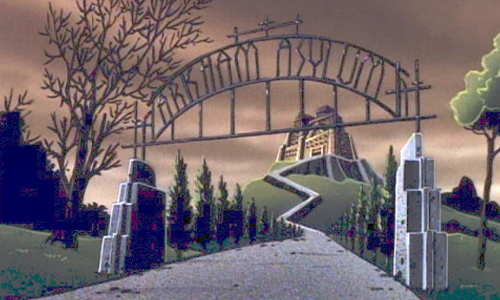
The actual first scene of the film is not the newsreel sequence, but several shots of Xanadu and finally Kane’s death. Then Welles cuts to the newsreel footage. This first scene draws a distinctly different portrait of Kane than the plot summary of the newsreel. We first see Xanadu from behind its barred gates. It resembles a prison more than a home. Am I the only one reminded of Arkham Asylum from Batman: The Animated Series?


The mansion is seen at night, completely dark but for one room and shrouded in fog. This comes in sharp contrast with the bright lights and images of the newsreel’s depiction of Kane’s life. When the camera finally brings us to Kane, the darkness and isolation of his home prepare the viewer for a man similarly alone in the world. When he does die, a nurse matter-of-factly pulls a sheet over his head and leaves. Though the newsreel mentions his solitary existence, the sadness of his situation is much more pronounced in the initial view that Welles gives his viewers. This scene also hints that “Rosebud” is not the name of an old girlfriend and is probably not as simple as the newsmen imagine. We can imagine that there must be some significance to the snow globe that falls from Kane’s hand. Why else would Welles cut to a shot taken from the shattered bauble’s perspective and why else would this be the last thing Kane held before his death?
These unanswered questions make it clear from the start that the film is going to be more about delving into the psychology of Charles Foster Kane than about his life itself. After the newsreel plot summary, we go over his life from a different “angle” as the reporters call it. The enjoyment we get from this film is not unlike the enjoyment gained from reading a book for a second time. We see details that otherwise would have escaped our notice and we get a richer perspective on the story. The editor in the screening room seems to be aware of this. He enjoyed the initial cut of the newsreel that Welles shows us but also feels that there needs to be more to make a truly quality product. This is a moment of meta-criticism for Welles and it seems to be a shot at the Hollywood establishment for making films that are enjoyable, fast-paced, but ultimately lacking the “angle” of a deeper meaning. Welles’ reporter and by extension his camera (and the viewers) go in search of that something extra and the end result is one of the classics of American cinema.
The actual first scene of the film is not the newsreel sequence, but several shots of Xanadu and finally Kane’s death. Then Welles cuts to the newsreel footage. This first scene draws a distinctly different portrait of Kane than the plot summary of the newsreel. We first see Xanadu from behind its barred gates. It resembles a prison more than a home. Am I the only one reminded of Arkham Asylum from Batman: The Animated Series?
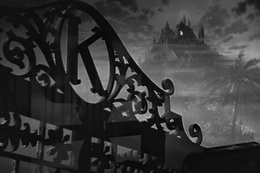
The mansion is seen at night, completely dark but for one room and shrouded in fog. This comes in sharp contrast with the bright lights and images of the newsreel’s depiction of Kane’s life. When the camera finally brings us to Kane, the darkness and isolation of his home prepare the viewer for a man similarly alone in the world. When he does die, a nurse matter-of-factly pulls a sheet over his head and leaves. Though the newsreel mentions his solitary existence, the sadness of his situation is much more pronounced in the initial view that Welles gives his viewers. This scene also hints that “Rosebud” is not the name of an old girlfriend and is probably not as simple as the newsmen imagine. We can imagine that there must be some significance to the snow globe that falls from Kane’s hand. Why else would Welles cut to a shot taken from the shattered bauble’s perspective and why else would this be the last thing Kane held before his death?
These unanswered questions make it clear from the start that the film is going to be more about delving into the psychology of Charles Foster Kane than about his life itself. After the newsreel plot summary, we go over his life from a different “angle” as the reporters call it. The enjoyment we get from this film is not unlike the enjoyment gained from reading a book for a second time. We see details that otherwise would have escaped our notice and we get a richer perspective on the story. The editor in the screening room seems to be aware of this. He enjoyed the initial cut of the newsreel that Welles shows us but also feels that there needs to be more to make a truly quality product. This is a moment of meta-criticism for Welles and it seems to be a shot at the Hollywood establishment for making films that are enjoyable, fast-paced, but ultimately lacking the “angle” of a deeper meaning. Welles’ reporter and by extension his camera (and the viewers) go in search of that something extra and the end result is one of the classics of American cinema.
Friday, October 16, 2009
The Object of the Male Gaze in Rear Window
Alfred Hitchcock’s Rear Window centers around a voyeuristic male character (Jimmy Stewart’s L.B. Jeffries) who is more interested in turning his gaze on men than on women. The voyeurism is not sexual however; Hitchcock takes pains to actually asexualize Jeffries. His background as a photography indicates that he might very well have a purely professional interest in spectacle. He sees his neighbors as subjects, not as objects of desire. He does enjoy watching the dancer who practices in her underwear, but no more than the composer or any of his other subjects. In fact, when Jeffries’ girlfriend Lisa visits him, he seems mostly disinterested in her presence, even when she is trying to arouse some sexual desire in him. At one point, the two are kissing near Jeffries’ window and Lisa can clearly tell that his attention is focused not on her, but on the people outside of his window. Until the end of the film, Jeffries has little to no sexual interest in Lisa or really anyone.
That being said, he does seem to prefer men to women when it comes to his subjects. He watches a newlywed couple, but after an initial shot of the wife, it is really only the man who comes into his frame of view. The woman is only heard off screen. Jeffries also spies on Miss Lonelyhearts (as he calls her), but is more concerned with the lack of a man in her life than with her. His attention is only really drawn to her when she finally succeeds in getting a male companion to take her on a date. Only when the man comes back to her apartment does Jeffries give her more than a cursory glance or mention. He also mostly skims over the dancer, though when he does look at her, she is mostly in the company of at least one man. And the subject with whom he eventually becomes obsessed is a man, Lars Thorwald. Thorwald is conspicuous precisely because there is NOT a woman in his life. He has killed his wife and this lack of a woman is what brings him to Jeffries’ attention.
This goes against Laura Mulvey’s claim in her article “Visual Pleasure and Narrative Cinema” where she states that “the presence of woman is an indispensable element of spectacle in normal narrative film” (203). Rear Window is entirely concerned with spectacle – the film revolves around the act of looking out a window – and yet women seem to quite dispensable to the primary spectator. Mulvey also claims that a woman’s “visual presence tends to work against the development of a story line, to freeze the flow of action in moments of erotic contemplation” (203). Again this does not hold true for Rear Window. Women on screen do not freeze Jeffries’ gaze more than men do. As for the women he sees out the window, their effect on the development of the plot is no different than the effect of the men. In fact, in the case of Lisa, she actually drives the action when she leaves Jeffries’ room, digs for evidence in the garden, and enters Thorwald’s apartment to gather evidence.
That being said, he does seem to prefer men to women when it comes to his subjects. He watches a newlywed couple, but after an initial shot of the wife, it is really only the man who comes into his frame of view. The woman is only heard off screen. Jeffries also spies on Miss Lonelyhearts (as he calls her), but is more concerned with the lack of a man in her life than with her. His attention is only really drawn to her when she finally succeeds in getting a male companion to take her on a date. Only when the man comes back to her apartment does Jeffries give her more than a cursory glance or mention. He also mostly skims over the dancer, though when he does look at her, she is mostly in the company of at least one man. And the subject with whom he eventually becomes obsessed is a man, Lars Thorwald. Thorwald is conspicuous precisely because there is NOT a woman in his life. He has killed his wife and this lack of a woman is what brings him to Jeffries’ attention.
This goes against Laura Mulvey’s claim in her article “Visual Pleasure and Narrative Cinema” where she states that “the presence of woman is an indispensable element of spectacle in normal narrative film” (203). Rear Window is entirely concerned with spectacle – the film revolves around the act of looking out a window – and yet women seem to quite dispensable to the primary spectator. Mulvey also claims that a woman’s “visual presence tends to work against the development of a story line, to freeze the flow of action in moments of erotic contemplation” (203). Again this does not hold true for Rear Window. Women on screen do not freeze Jeffries’ gaze more than men do. As for the women he sees out the window, their effect on the development of the plot is no different than the effect of the men. In fact, in the case of Lisa, she actually drives the action when she leaves Jeffries’ room, digs for evidence in the garden, and enters Thorwald’s apartment to gather evidence.
Thursday, September 24, 2009
Film Review: The Informant!
The highest ranking executive ever to turn state’s evidence in a case of corporate fraud, Mark Whitacre once served as a biotech division president for Archer Daniels Midland (ADM), one of the largest food and ingredients companies in the world. Based on this true story, Steven Soderbergh’s The Informant! opens with Whitacre (played by an overweight, typically boyish Matt Damon) pleasantly ensconced in a plush corporate lifestyle. He lives for his job as a biochemist turned executive, breathlessly describing the revolutions in corn technology to his politely disinterested wife and children whenever he finds the time to get out of the office. As Whitacre drives this captive audience through rural Illinois in one of his myriad high-priced cars, Soderbergh’s camera flips upside down to follow Whitacre and his corn-based ramblings. This shot turns out to be a telling symbol for the film as a whole: Mark Whitacre’s life is about to be turned on its head.
The first half of Whitacre’s story plays out like the typical tale of a corporate whistleblower. Encouraged by his wife Ginger (Melanie Lynskey) to “do the right thing,” Whitacre reveals to FBI agents that his company is engaged at the highest level in international price fixing deals. Convinced to wear a wire, he then gathers hundreds of tapes of evidence that build the government’s case against ADM and bring indictments against many of his friends and coworkers. We get a few laughs at Whitacre’s expense, mostly due to the straight faced acting of Damon who maintains an earnest seriousness throughout his character’s semi-comic missteps and mistakes.
But if this were the whole film, Soderbergh would simply be rehashing territory he covered to wide acclaim in Erin Brockovich – Everyman David brings down corporate Goliath. Instead, the director slowly reveals that Whitacre is not the white knight he makes himself out to be. Whitacre lies to the FBI initially about a few small matters and his first betrayals of their trust we write off as mistakes of a man who has never dealt with the pressures of working undercover. However, these lies soon spiral out of control and we begin to realize that the lines between good and corrupt in his world are blurry at best. The audience learns of each deception with the same disbelief as the characters onscreen. Blindside after blindside hits us until we eventually realize that Whitacre has embezzled millions of dollars from his company at the same time as his work with the FBI to bring down the fraudulent price fixers.
Once the lies begin, Soderbergh keeps them coming as the movie’s fast pacing mirrors the snowballing of Whitacre’s life. The dark comedy is rampant here as Damon’s Whitacre assures the audience and the other characters that each lie is his last, that he’s finally come out with the full truth, only to reveal another more fantastic fabrication. Each time the embezzlement comes up, the amount stolen has grown. The audience can’t help but laugh at the absurdity of it all as what we first believe was a couple hundred thousand dollars balloons into over nine million in embezzled funds. We can laugh when Whitacre accuses his former friend and FBI handler of assaulting him with a briefcase, but the stark reality of a man grasping at the last straws of livelihood is never far from the surface.
Therein lies the appeal of this film, the double-edged sword of a man who does both the right and wrong thing. Subversive in his humor, Soderbergh breaks down the audience’s trust in Whitacre as a narrator. Like the lies, Whitacre’s interior monologues are humorous at first, but end up deeply sad, overlapping his spoken words as we see the man’s final breaking point. The movie, like its protagonist, is devilishly ambivalent. Is it humorous or tragic? Was Whitacre given a raw deal or did he get what he deserved? In the end, is he a good guy or a bad guy? Soderbergh never gives us the answer to these questions, instead leaving it up to the audience to decide for ourselves. Ultimately, the message seems to be that life is not as clear cut as the endings and answers we are accustomed to finding in the movies. This mentally challenging, psychologically dense tragicomedy signals the end of the summer blockbusters and ushers in the beginning of Oscar season. Hollywood kicks things off on the right foot with this gem from Soderbergh.
Three and a Half Stars / Four
The first half of Whitacre’s story plays out like the typical tale of a corporate whistleblower. Encouraged by his wife Ginger (Melanie Lynskey) to “do the right thing,” Whitacre reveals to FBI agents that his company is engaged at the highest level in international price fixing deals. Convinced to wear a wire, he then gathers hundreds of tapes of evidence that build the government’s case against ADM and bring indictments against many of his friends and coworkers. We get a few laughs at Whitacre’s expense, mostly due to the straight faced acting of Damon who maintains an earnest seriousness throughout his character’s semi-comic missteps and mistakes.
But if this were the whole film, Soderbergh would simply be rehashing territory he covered to wide acclaim in Erin Brockovich – Everyman David brings down corporate Goliath. Instead, the director slowly reveals that Whitacre is not the white knight he makes himself out to be. Whitacre lies to the FBI initially about a few small matters and his first betrayals of their trust we write off as mistakes of a man who has never dealt with the pressures of working undercover. However, these lies soon spiral out of control and we begin to realize that the lines between good and corrupt in his world are blurry at best. The audience learns of each deception with the same disbelief as the characters onscreen. Blindside after blindside hits us until we eventually realize that Whitacre has embezzled millions of dollars from his company at the same time as his work with the FBI to bring down the fraudulent price fixers.
Once the lies begin, Soderbergh keeps them coming as the movie’s fast pacing mirrors the snowballing of Whitacre’s life. The dark comedy is rampant here as Damon’s Whitacre assures the audience and the other characters that each lie is his last, that he’s finally come out with the full truth, only to reveal another more fantastic fabrication. Each time the embezzlement comes up, the amount stolen has grown. The audience can’t help but laugh at the absurdity of it all as what we first believe was a couple hundred thousand dollars balloons into over nine million in embezzled funds. We can laugh when Whitacre accuses his former friend and FBI handler of assaulting him with a briefcase, but the stark reality of a man grasping at the last straws of livelihood is never far from the surface.
Therein lies the appeal of this film, the double-edged sword of a man who does both the right and wrong thing. Subversive in his humor, Soderbergh breaks down the audience’s trust in Whitacre as a narrator. Like the lies, Whitacre’s interior monologues are humorous at first, but end up deeply sad, overlapping his spoken words as we see the man’s final breaking point. The movie, like its protagonist, is devilishly ambivalent. Is it humorous or tragic? Was Whitacre given a raw deal or did he get what he deserved? In the end, is he a good guy or a bad guy? Soderbergh never gives us the answer to these questions, instead leaving it up to the audience to decide for ourselves. Ultimately, the message seems to be that life is not as clear cut as the endings and answers we are accustomed to finding in the movies. This mentally challenging, psychologically dense tragicomedy signals the end of the summer blockbusters and ushers in the beginning of Oscar season. Hollywood kicks things off on the right foot with this gem from Soderbergh.
Three and a Half Stars / Four
Friday, September 11, 2009
Sleepless in Seattle
Watching Sleepless in Seattle, it feels as if director Nora Ephron has read David Bordwell’s essay “Classical Hollywood Cinema: Narrational Principles and Procedures” and intentionally modeled her movie after the conventions he lays out. Sleepless matches up almost perfectly to Bordwell’s definition of a classical Hollywood film.
Bordwell’s first claim is that “the classical Hollywood film presents psychologically defined individuals who struggle to solve a clear-cut problem or to attain specific goals.” Very early in the film, the psychological motivations of both Sam (Tom Hanks) and Annie (Meg Ryan) are made clear and the goals or problems they deal with follow from those motivations. Sam loves his son Jonah and misses his deceased wife; his problem or goal is to find a new woman to love and fill the void in his life. Annie wants to find a man who can satisfy her idealized vision of love, a vision that is shaped by her mother’s memories and Cary Grant films.
He then posits “a double causal [narrative] structure, two plot lines.” The first plot line involves heterosexual romance. In Sleepless this is obviously the long distance love interest between Sam and Annie. Will they ever meet? Are they actually meant to be together as the film would have us believe? The other plot line involves “another sphere” of the characters’ lives; in this case it seems to be “other personal relationships.” The film spends a lot of time developing Sam’s relationship with Jonah and Annie’s relationship with her fiancé. Sam wants to make his son happy by finding another woman to be with and Annie must determine if her fiancé is actually the man she is meant to be with. Of course these plot lines tie in very closely to the heterosexual love interest but they are ultimately distinct. Annie’s struggle fits this especially well. The climax of this narrative is when she returns her engagement ring to her fiancé and leaves to find Sam on the Empire State Building.
Also typical of classic Hollywood is the happy ending. Although we never know for sure what happens once Sam and Annie finally meet in person (we never even see them hold a conversation), clues in the film indicate that they will live ‘happily ever after.’ Both characters have conversations about the magic of love when hands touch for the first time. Ephron’s camera focuses in on Sam and Annie’s hands as when they first meet and the implication is that they have experienced that magic. I imagine that if the electricity hadn’t been present the two would have dropped hands immediately, realizing that it simply wasn’t meant to be. The looks on their faces and the continued physical contact of hand holding indicate that Sam and Annie have in fact met their respective soul mates.
Beyond conventions of plot or syuzhet, Bordwell lays out some specific narrative hallmarks of classic Hollywood films. He says that “classical narration tends to be omniscient, highly communicative, and only moderately self-conscious.” The narrator in Sleepless in Seattle is the camera; there are no voiceovers or omniscient characters. The camera itself is omniscient though because it reveals to the viewer the thoughts and actions of both protagonists even though they are separated by the distance of the American continent. We see Sam’s half-dreaming conversation with his deceased wife. We see Annie pour out her doubts to her friend only to present a very different face in public and with her fiancé. Incidences like these contribute to the viewer having a perspective on events that is above and beyond any character; we know the actions and thoughts that are happening at all times, even when they are known to only one person within the movie. This narrative omniscience goes along with the communicative aspect of classical narration – Ephron never leaves any gaps in our knowledge. Events move forward in a basic cause and effect manner; if any information is cut out, the dialogue fills us in on what we missed. This device is never obvious though; the narration is mostly covert. The one device that does indicate moderate self-consciousness is the technique of showing the map of the United States and the path of a plane to indicate that characters are traversing time and distance. Like the rest of the film techniques in Sleepless though, this is simply a vehicle for the transmission of the story; the film is plot driven rather than overtly concerned with style.
So Sleepless in Seattle fits neatly into Bordwell’s conventions of a classic Hollywood movie. To me, this is actually the film’s biggest weakness – it is too conventional. Ephron never takes us out of our comfort zone as we watch her movie. Once events get set in motion, we can easily predict what will happen next. Sam and Annie, despite a few bumps in the road, will eventually get together and have a joint happy ending. In order to make a more memorable or enjoyable film, Ephron should have bucked the conventions in at least a few minor ways. By following the classical formula so closely, she left very little doubt or tension as to what would ultimately happen. In an effort to make her film different from other classical movies that followed the same basic outline, the director ended up with a premise that seems too far fetched to be believable. Why would two people who have never met and live on opposite ends of the country fall in love? To the viewer, the answer to this question is irrelevant because we know that, as a film made in the classical Hollywood style, the movie will conclude with Sam and Annie falling in love. Efforts to answer the “why” largely fall flat as Ephron relies on our preconceived expectations of a happy ending to justify the unbelievability of her film.
Bordwell’s first claim is that “the classical Hollywood film presents psychologically defined individuals who struggle to solve a clear-cut problem or to attain specific goals.” Very early in the film, the psychological motivations of both Sam (Tom Hanks) and Annie (Meg Ryan) are made clear and the goals or problems they deal with follow from those motivations. Sam loves his son Jonah and misses his deceased wife; his problem or goal is to find a new woman to love and fill the void in his life. Annie wants to find a man who can satisfy her idealized vision of love, a vision that is shaped by her mother’s memories and Cary Grant films.
He then posits “a double causal [narrative] structure, two plot lines.” The first plot line involves heterosexual romance. In Sleepless this is obviously the long distance love interest between Sam and Annie. Will they ever meet? Are they actually meant to be together as the film would have us believe? The other plot line involves “another sphere” of the characters’ lives; in this case it seems to be “other personal relationships.” The film spends a lot of time developing Sam’s relationship with Jonah and Annie’s relationship with her fiancé. Sam wants to make his son happy by finding another woman to be with and Annie must determine if her fiancé is actually the man she is meant to be with. Of course these plot lines tie in very closely to the heterosexual love interest but they are ultimately distinct. Annie’s struggle fits this especially well. The climax of this narrative is when she returns her engagement ring to her fiancé and leaves to find Sam on the Empire State Building.
Also typical of classic Hollywood is the happy ending. Although we never know for sure what happens once Sam and Annie finally meet in person (we never even see them hold a conversation), clues in the film indicate that they will live ‘happily ever after.’ Both characters have conversations about the magic of love when hands touch for the first time. Ephron’s camera focuses in on Sam and Annie’s hands as when they first meet and the implication is that they have experienced that magic. I imagine that if the electricity hadn’t been present the two would have dropped hands immediately, realizing that it simply wasn’t meant to be. The looks on their faces and the continued physical contact of hand holding indicate that Sam and Annie have in fact met their respective soul mates.
Beyond conventions of plot or syuzhet, Bordwell lays out some specific narrative hallmarks of classic Hollywood films. He says that “classical narration tends to be omniscient, highly communicative, and only moderately self-conscious.” The narrator in Sleepless in Seattle is the camera; there are no voiceovers or omniscient characters. The camera itself is omniscient though because it reveals to the viewer the thoughts and actions of both protagonists even though they are separated by the distance of the American continent. We see Sam’s half-dreaming conversation with his deceased wife. We see Annie pour out her doubts to her friend only to present a very different face in public and with her fiancé. Incidences like these contribute to the viewer having a perspective on events that is above and beyond any character; we know the actions and thoughts that are happening at all times, even when they are known to only one person within the movie. This narrative omniscience goes along with the communicative aspect of classical narration – Ephron never leaves any gaps in our knowledge. Events move forward in a basic cause and effect manner; if any information is cut out, the dialogue fills us in on what we missed. This device is never obvious though; the narration is mostly covert. The one device that does indicate moderate self-consciousness is the technique of showing the map of the United States and the path of a plane to indicate that characters are traversing time and distance. Like the rest of the film techniques in Sleepless though, this is simply a vehicle for the transmission of the story; the film is plot driven rather than overtly concerned with style.
So Sleepless in Seattle fits neatly into Bordwell’s conventions of a classic Hollywood movie. To me, this is actually the film’s biggest weakness – it is too conventional. Ephron never takes us out of our comfort zone as we watch her movie. Once events get set in motion, we can easily predict what will happen next. Sam and Annie, despite a few bumps in the road, will eventually get together and have a joint happy ending. In order to make a more memorable or enjoyable film, Ephron should have bucked the conventions in at least a few minor ways. By following the classical formula so closely, she left very little doubt or tension as to what would ultimately happen. In an effort to make her film different from other classical movies that followed the same basic outline, the director ended up with a premise that seems too far fetched to be believable. Why would two people who have never met and live on opposite ends of the country fall in love? To the viewer, the answer to this question is irrelevant because we know that, as a film made in the classical Hollywood style, the movie will conclude with Sam and Annie falling in love. Efforts to answer the “why” largely fall flat as Ephron relies on our preconceived expectations of a happy ending to justify the unbelievability of her film.
Monday, August 31, 2009
Fight Club, Walter Benjamin, and Film Narrative
I have to disagree with Dulac’s claim that it is a “criminal error” to believe that narrative is the essence of film. She is of course right that much of the appeal of film lies in its ability to capture in close-up or slow motion events or objects in our everyday lives that we would not be able to see with normal human eyes. This is a unique and essential quality to making a lasting film. However, I believe that the central value of a film must begin with the narrative structure. Without a compelling narrative, the film cannot hold its audience’s interest and thus loses much of its value. Avant-garde films that rely simply on images that are zoomed in or slowed down struggle for meaning much more than do films that couple those super-sensory shots with a meaningful storyline. “Fight Club” is a perfect example of this. The spliced images that continually pop into the film and into the viewer’s subconscious produce an effect that is only possible through film technologies. As Walter Benjamin says, “for the entire spectrum of optical, and now acoustical, perception the film has brought about a … deepening of apperception.” When Tyler Durden pops into the film for a single frame (as he does several times), this creates an effect outside of narration that otherwise would be impossible. Assuming that the viewer is able to notice
Subscribe to:
Comments (Atom)